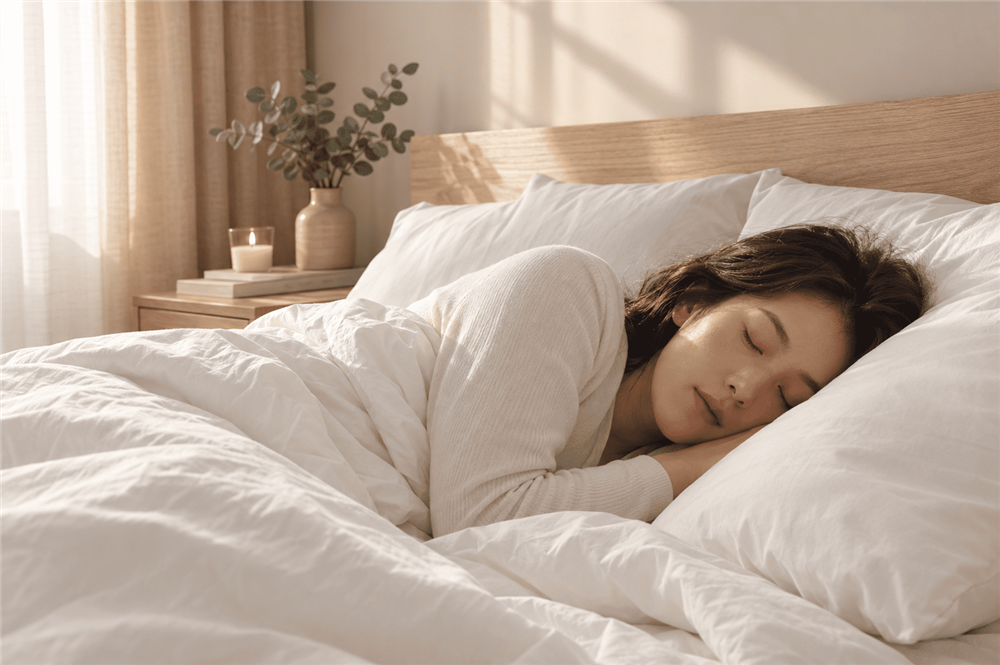
Learning how to sleep faster is a skill, and like any skill, it improves with the right techniques and a little practice. If you regularly spend half an hour staring at the ceiling, a few evidence-based methods can shorten that frustrating gap between lights off and actual sleep.
7 Techniques to Fall Asleep Faster
1. Try the Military Method
The military method is a full-body wind-down developed to help soldiers fall asleep in around two minutes in far-from-ideal conditions. Relax your face completely, including your jaw and the muscles around your eyes. Drop your shoulders, let your arms hang loose, then relax your chest, thighs, and calves in turn. Finally, clear your mind by picturing a calm scene, such as lying in a canoe on a still lake, for ten seconds. With nightly practice, the sequence becomes a trigger your body associates with sleep.
2. Use 4-7-8 Breathing
The 4-7-8 pattern is a slow breathing exercise that activates the parasympathetic nervous system and lowers heart rate, the body’s natural brake pedal. Rest the tip of your tongue behind your upper front teeth, inhale quietly through your nose for a count of four, hold for seven, then exhale fully through your mouth for eight. Repeat the cycle about four times and you should feel your body noticeably soften into the mattress.
3. Do a Progressive Muscle Relaxation Scan
Progressive muscle relaxation helps release physical tension by deliberately tightening and relaxing muscle groups in sequence. Starting at your toes, gently tense each muscle group, release it fully, and notice the contrast before working slowly through the legs, torso, arms, and face. A 2026 review of 31 randomised trials found that progressive muscle relaxation improved sleep quality, making it a useful addition to a regular bedtime wind-down.
4. Give a Racing Mind Something Boring to Do
If overthinking is what keeps you awake, occupy your brain with a task that is easy but just engaging enough to block those repetitive thoughts.. One approach, sometimes called cognitive shuffling, involves picking a random letter and listing unrelated words that start with it, moving on whenever a word starts to feel interesting. Visualising a slow, detailed scene, such as walking through a familiar garden, works on the same principle: the mind stays gently busy while the body slips towards sleep.
5. Keep Your Bedroom Cool, Dark, and Quiet
Your environment either helps every technique above or fights it. Health authorities advise you to keep the bedroom cool and remove light and sound distractions so your body can lower its core temperature, a natural trigger for sleepiness. In Malaysia, that usually means air conditioning or a fan, blackout curtains, and breathable bedding that does not trap heat against your skin.
6. Follow the 20-Minute Rule
Lying in bed frustrated teaches your brain to associate the bed with wakefulness. Sleep specialists recommend that if you are still awake after about 20 minutes, you should get out of bed and do a quiet activity in low light, avoiding electronics, and return only when you feel drowsy. It feels counterintuitive, but protecting the bed-sleep association helps you nod off faster on every future night.
7. Cut Caffeine at Least 6 Hours Before Bed
A placebo-controlled randomised crossover trial published in Sleep found that 400 mg of caffeine delayed sleep onset and altered sleep architecture when consumed within 12 hours of bedtime. By contrast, 100 mg consumed four hours before bed did not significantly affect sleep in this trial. The study involved 23 healthy men, so individual sensitivity should still be considered.
What to Avoid When You Want to Sleep Fast
A few common habits quietly sabotage even the best technique. Watching the clock feeds the exact anxiety that keeps you awake, so turn it to face away from you. Scrolling on your phone keeps the brain stimulated when it should be powering down, which is why sleep specialists advise avoiding screens and electronics in the wind-down before bed. Above all, avoid trying to force sleep. Sleep arrives when pressure drops, so focus on relaxing your body and let sleep follow on its own schedule.
Comfort Is the Technique You Only Set Up Once
Breathing patterns and muscle scans work best when nothing physical is pulling you back awake. On warm and humid nights, sticky sheets and a heat-trapping pillow will undo a perfect wind-down, which is why a cool, comfortable bed is the one sleep technique you only need to set up once.
AKEMI has been Malaysia’s No. 1 bedding brand consecutively since 2012 (based on Nielsen Research 2023), with a range engineered for fast, comfortable sleep in tropical weather. AKEMI TENCEL™ bed linen, made with genuine fibres through the brand’s official TENCEL™ partnership with Lenzing, wicks moisture and stays cool against the skin, while Outlast® heat-regulating pillows and SensICE cooling fabric technology manage warmth before it wakes you. Together with HeiQ Viroblock hygiene treatments across its pillow collection and bedding, AKEMI builds the kind of sleep surface that lets a five-minute wind-down actually finish in five minutes.
Set the stage for faster sleep tonight. Explore AKEMI’s cooling, breathable bedding today.
FAQs
What is the military sleep method?
The military method is a relaxation sequence in which you systematically release tension from your face down to your legs, then clear your mind with a calming mental image for ten seconds. It was designed to help soldiers fall asleep in around two minutes and typically takes several weeks of practice to reach full effect.
How does the 4-7-8 breathing method help you sleep?
The 4-7-8 method slows your breathing to a pace that activates the body’s rest-and-digest response, lowering heart rate and easing anxiety. You inhale for four counts, hold for seven, and exhale for eight, repeating the cycle around four times as you settle into bed.
Why can I not fall asleep even when I feel tired?
The usual culprits are an overactive mind, late caffeine, screen use before bed, or a bedroom that is too warm or bright. Feeling tired is not the same as feeling sleepy, and stress hormones can keep the brain alert even in an exhausted body. Relaxation techniques and a consistent wind-down routine usually close that gap.
Is falling asleep in under 5 minutes a good sign?
Occasionally, yes, it simply means you were relaxed and ready for bed. If you crash instantly every single night and still wake up tired, it may signal sleep deprivation rather than healthy sleep. Persistent daytime sleepiness despite full nights in bed is worth discussing with a doctor.
Sources
- American Academy of Sleep Medicine (Sleep Education) - Healthy Sleep Habits
- Cleveland Clinic - Will You Really Fall Asleep in Two Minutes With the Military Sleep Method?
- Cleveland Clinic - How To Do the 4-7-8 Breathing Exercise
- Michigan Medicine - Anxiety Exercises: Mindfulness, PMR & Breathing Exercises for Anxiety Relief
- National Library of Medicine (Journal of Clinical Sleep Medicine) - Caffeine Effects on Sleep Taken 0, 3, or 6 Hours before Going to Bed
- NIH News in Health - Good Sleep for Good Health